
For most Lebanese people, going to a governmental hospital means suffering from the insufficient, overburdened, and underfunded public healthcare sector. Meanwhile, opting for the private sector means paying out-of-pocket on expensive healthcare services that are often inaccessible to a large portion of the population. However, it seems both sectors are under-equipped in dealing with chronic injury, surgery recovery, physical and/or cognitive disability. This means that our healthcare system is especially exclusive of persons with disability, who make up 10-15% of the population, requiring advanced healthcare services. Now, imagine dealing with this lack of services, visibility, and healthcare while being a student. This is the reality of disabled students achieving a higher education in Lebanese institutions.
For the young, disabled students of Lebanon, barriers to higher education arise even before entering university. Abundant disability-related costs, due to the extortionate nature of Lebanese healthcare, on top of the tuition bills of private educational institutions are almost impossible for any average Lebanese person to cover. Despite these financial constraints, AUB, like most other universities in Lebanon, does not provide specific financial support systems for capable, promising yet disadvantaged students. In the end, this forces many disabled students to choose universities based on affordability and proximity to care-takers/guardians rather than opportunity when faced with the expensive tuition and an inaccessible campus. This marginalization on AUB campus is merely a reflection of the wider Lebanese culture regarding disability. When it comes to making societal changes, shifting cultural narratives in higher education institutes harboring Lebanese youths is vital for making shifts across Lebanese society.
Ideally, AUB’s Accessible Education Office (AEO) would provide “necessary adjustments,” as stated in accommodations request form, that allow every student “equal access to the course or educational experience.” Mainly, it seems that they provide accommodation for neurodivergency (i.e ADHD, Autism, dyslexia…), social anxiety, mental health, and visual impairments. This includes simple measures such as providing extended times for exams/assignments, allowing the use of assistive technology, and giving alternative graded tasks. Although, the actual application of these accommodations is often called into question depending on the nature of the course and its professor.
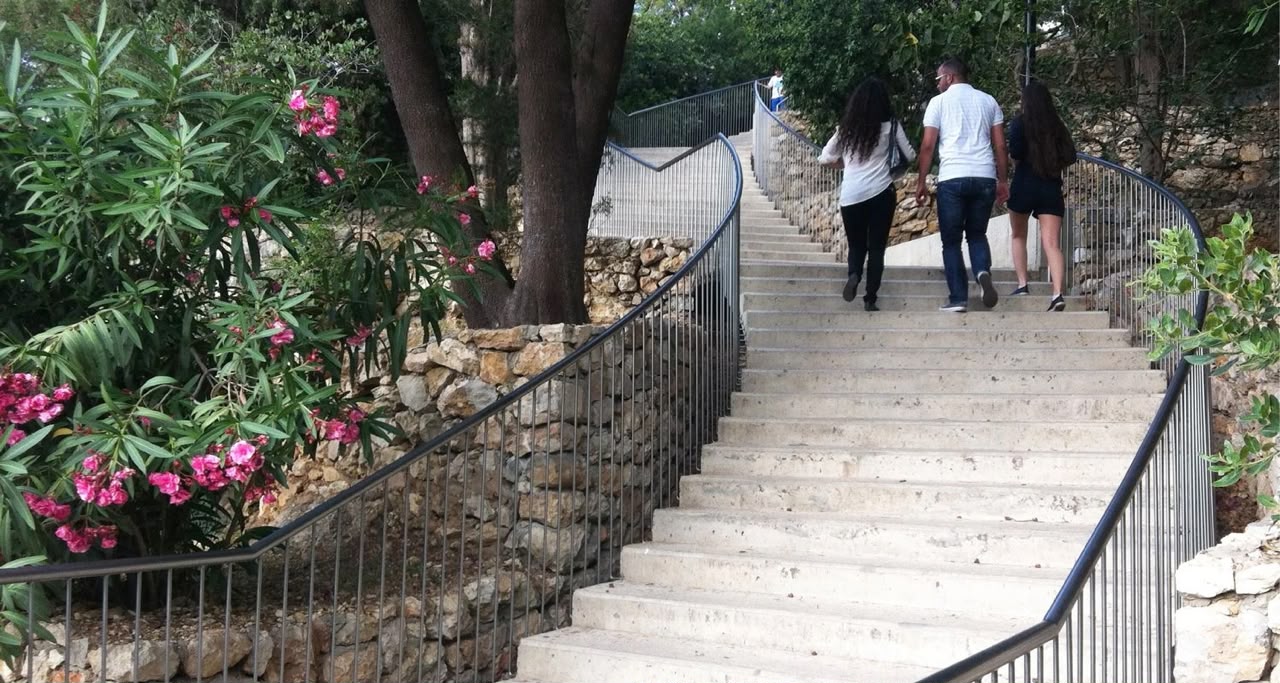
When it comes to physical disabilities, the accommodations are somehow even worse. According to the List of Accommodations, “separate test location,” “help of a scribe,” and “not penaliz[ing] him/her for tardiness” are provided for students with physical disabilities and mobility issues. For the most part, this list targets access to course learning and exam taking. Yet, it remains so that it is embarrassingly short, not at all effective in covering the needs of students with physical disabilities that allows them access to campus that facilitate continued education. The walk from upper campus to lower campus, and even worse, the climb up, is a struggle without all the additional obstacles. Instead of providing sufficient accommodation that would allow students with physical disabilities to tackle the hills, steep stairs, and uneven terrain, the list provides a cop-out, a quick-fix, that does not provide students with a satisfying experience of campus. For example, although there are ramps scattered throughout campus, they do not reconcile the use of any assistive technology, such as wheelchairs or crutches. Add to that the fact that, more likely than not, you will be met with another set of stairs as soon as you cross said ramp, rendering them somewhat useless. This leaves one last option: hiking the steep AUB hills, which, for obvious reasons, is not an option when using any mobility aid. In the pursuit of an accessible education, it is vital to integrate accommodations, such as effective ramps, specialized transport, and elevator access, for a shared experience of campus life.
All this to say, AUB lacks a clear, effective policy that would allow students with disabilities equitable access to the education they offer everyone else. From the application, financial process to the day-to-day campus life as a student, the barriers to entry/access for disabled Lebanese students keep stacking up. I mean, when was the last time you saw a wheelchair user on AUB campus? Even professors, many in their elderly age, have described the struggle of commuting from their offices in lower campus to classes inconveniently located on upper campus. The AEO archives report that 57% of the 138 students with registered disabilities were psychological, while only a combined 10% were physical/medical or mobility related. While this is a minimal number of students compared to the total number of AUB students, it does reflect the strict documentation guidelines that may accidentally exclude some students. This includes having to submit proof eligibility every semester, which although necessary, has the unintentional side-effect of treating disability like a static, easily-defined category to be proven by a bunch of papers and official stamps that say so. It also means deterring potential students from applying due to the rigorous, stringent requirements that only lead to insufficient accommodations for their specific needs as demonstrated in the previous paragraph.
Disability cannot be discussed without bringing up the stigma surrounding the topic in Lebanese society at large. Disability is not synonymous with inability as many people treat it to be. Rather, it is a wide spectrum of different variations in human functioning that can be mental or physical. For example, a person using a wheelchair is capable of independently accessing a building, but the stairs specifically dictates their deficit capability. As a result of these misconstrued definitions, many students may not even disclose their disability due to fear of discrimination and negative perception from peers. As such, AUB’s statement on “maintaining the privacy and confidentiality of all information related to students seeking accommodation services” is vital in adhering to ethical standards that protect student’s wellbeing. Nevertheless, this stigma can extend beyond accommodations and into the student culture surrounding disability, in which our peers may perpetuate discriminatory statements and a lack of understanding that impacts the education of students with disabilities. Therefore, harboring a safe environment, through open discussion that addresses these misunderstandings on campus is also important in ensuring students don’t fear the stigma often associated with having a disability.
Students must be provided their rightful accommodations, while addressing the physical, medical, and social needs important in allowing them to maintain independence in their pursuit of education. I hope for this to be achieved on AUB campus to make it an inviting environment for more students of all walks of life to apply and continue to attend. We must begin developing and then implementing policies that push students with disabilities to the forefront of the conversation. For example, providing financial aid systems that recognize the added ongoing expenses disabled students face outside campus. It is vital to make campus a truly accessible campus that makes it easier for students with disabilities to move across. Equally important to that is creating a campus culture which acknowledges that disability is not a monolithic experience, but rather a complex set of challenges that cannot be boxed within a few documentary papers.
Edited By Amin Kharrat and Nisreen Yassine