
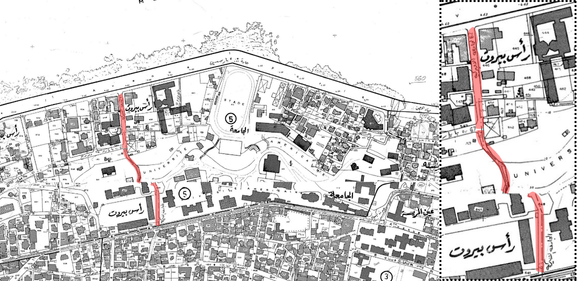
Road No. 62, as can be seen in the below cadastral maps of Beirut, is one of the easiest ways to cross from Bliss to Manara. Yet, despite the road being clearly marked as part of the public domain, the only way to cross it is by paying around $20,000 a year to a private institution. Closed off by the American University of Beirut’s Bliss Gate, this road has been effectively annexed into AUB, with only the institution’s ID-card holders allowed to cross the checkpoint.
This is part of a larger trend of securitization and commodification that the university’s administration has pursued over the past few years. This trend crystalized in 2021, when AUB, after close to two years of unpopular decisions and intense student protests, moved to completely close off its campus. Initially citing COVID-19 concerns as its motive for instituting stricter entry protocols, the administration has never looked back. Restricted campus access is set to continue for another academic year, despite the university’s COVID-19 Expert Committee last releasing a statement in October 2022.
Today, AUB has effectively created an enclave in Ras Beirut, shutting out the majority of the country’s population from its 250,000 m2 seafront grounds.
Cadastral Map of Ras Beirut, 1966. Road No. 62 highlighted.
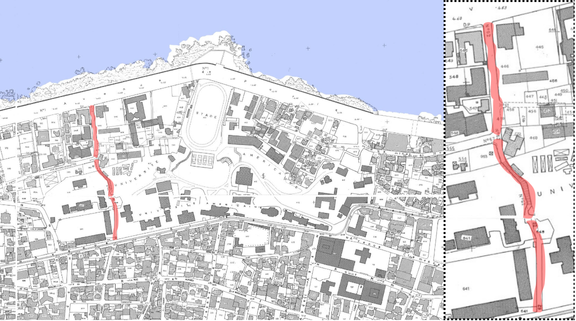
Cadastral Map of Ras Beirut, 2004. Road No. 62 highlighted.
Securitization
AUB’s main campus sits on 61 acres of land in the heart of Beirut on a hill overlooking the Mediterranean Sea, with Bliss Street serving as its southern border and Manara its northern. The university occupies prime real estate on Ras Beirut’s seafront.
For most of its 157-year run, AUB’s campus was somewhat open to the public. Even though the gates, doors, and series of walls and fences have always existed, one could choose to visit the campus without having business there. I remember walking around AUB frequently as a high school student, and no one ever stopped me. Security would sit at the gate, eye you, but ultimately let you pass.
AUB’s securitization was a slow and gradual process. In 2018, when I began my undergraduate studies, I could go in and out without showing my student ID. Granted, I was a teenage girl who “looked” like a student so my anecdote probably doesn’t align with everybody’s experiences. But in general, for every five people who passed, one person would be asked to show their ID. Less so when there was a lot of foot traffic, and security couldn’t be bothered to stop the barrage of students going in and out of the gate in waves.
In 2019, Lebanon experienced civil unrest, and consequently, AUB’s guidelines tightened, with students now asked to show their IDs more frequently. “Sneaking in” was still possible, but required more finesse. But it would only really get serious a year or so later.
Halfway through the Spring 2020 semester, campus closed due to COVID lockdowns and would not open back up for students until Fall 2021, over a year and a half later. Coming back from lockdown, students were greeted with an ID scanner at the gate, and an increased number of security officers milling around. To enter the university, you now had to scan your AUB ID, whether you were a student, staff member, faculty, or alumnus.
It’s important to note that these stricter measures came during a rocky time for the university’s administration. Intent on pursuing further and further tuition hikes, the university was facing resistance from student groups who were mounting various protests against the university. Of course, AUB went on with business as usual and did not heed, or most of the time even acknowledge, the protests.

AUB Main Gate, 2023, by author.
Entering AUB’s campus without an ID now requires extensive proof. Proof of appointment, proof of life. They’d have you present your criminal record if they could. You can’t go in just because. You can’t just want to walk around. You can’t just want to sit in the grass. You can’t just want to sit in the library to work or study (they hardly have guest wifi anyway). You must go up to the security desk at the Main Gate and show them some form of proof. If you attempt to enter through other gates without an ID they will redirect you to the Main Gate. You cannot escape the security desk. Even when you do have an appointment, they make you wait so they can verify, make their appropriate calls, and check their respective boxes. What’s more, if you are a student but haven’t registered for classes yet for the semester, your ID scan will be red and you will be denied entry. What’s the point of denying the entry of someone who is clearly an AUB student? Why is security going out of its way to inconvenience students and create traffic at the gate? They confiscate IDs left and right, too, and then charge you a $25 lost fee when you try and get a new one.
In 2021, the AUB administration cited COVID, saying we shouldn’t have more people on campus than is necessary, which is fair. However, the strict rules are still in place, and it doesn’t look like they’re letting up any time soon.
The university underwent many controversial moments in 2020 and 2021, from laying off over 800 AUBMC workers in July 2020, to increasing tuition gradually by changing the dollar rate, to underpaying and overworking their part-time instructors and daily wage workers, to completely dollarizing the tuition. All these decisions and more were met with countless protests, by staff, faculty, students, and the general public. AUB did not hesitate to deploy its own security and the Internal Security Forces and Army, on several occasions, to quell them.

Credit: Rabih Yassine / Protests at the AUB gates, December 2020
The over-securitization of AUB as it went through this violent restructure is almost identical to how the state, and other capitalist enterprises, carry out their affairs. While constantly refusing to engage in any productive dialogue, the AUB administration instead chose force over and over again, with its complete control and surveillance of campus access being one of its bigger exertions. Given that AUB has itself brutalized its own students, over and over again, via its own security and policies, and the repressive tools of the state police, what exactly are they protecting their students from now? A look through AUB’s history shows that deploying empty words about protection while unleashing unprecedented violence upon the student body is not a recent innovation.
Enclosure
The university has a long history of oppressing its students and their voices. Before the Lebanese Civil War, particularly in the 60s and early 70s, student movements in Lebanon were quite active in demanding their rights. Influenced by international protests for peace, workers’ and student rights, students in Lebanon often organized sit-ins, protests, boycotts, and strikes to get their messages to administrations across. AUB has had multiple notable strikes throughout its history. While not all demonstrations were to protest the AUB administration, the two most notable ones, the 1971 and the 1974 student occupations, were.
In 1971, AUB students went on a 22-day strike to protest a 10% tuition increase announced by then-AUB President Samuel Kirkwood, occupying a series of administrative buildings across campus during their strike. In her book, The American University of Beirut: Arab Nationalism and Liberal Education, Betty S. Anderson detailed the students’ reasoning behind the strike, stating:
“The students explicitly questioned the administration’s authority to demarcate and narrow their desired experiential education. In the process, students used the same actions and vocabulary to fight both governmental and AUB authority simultaneously. Their desire to overthrow oppressive and imperialist governments matched their desire to participate in campus administrative decision-making.” (p. 152)
AUB holds a double standard for its students. It wants them to question authority and fight for their rights as long as it’s convenient for them. They want the students to stand up to their rulers, but not their President. They want them to go out and protest for their civil rights, but not their student rights.
Despite the occupation, the 1971 strike was relatively peaceful. Students had taken control of buildings inside a university they considered theirs, and they had demands. They wanted a reversal of the tuition increase as well as an investigation into possible tuition decrease. Even though the occupation ended with students promised that their demands would be heard, the 1970-71 academic year was eventually suspended, with the Student Council also suspended (brought back that fall after protests and pressure from the Lebanese president), and the 10% tuition increase forced through next fall. AUB’s pattern shines through, so much so that Kirkwood’s annual report at the time reads like something current President Fadlo Khuri would send in an email.
“Dissent is highly prized in an association of scholars and scientists such as we have at AUB and must be preserved. But dissent withoutmutual respect for differing opinions is not acceptable in a university community… Freedom is only valid within a system of law.”
Students kept up their activism in the years leading up to the Civil War, with the biggest event being a 41-day strike in March-April 1974, the longest in AUB history. Much like the 1971 strike, students occupied buildings in protest against another 10% tuition increase. This time around, however, the protesting wasn’t as “peaceful”. Most building surfaces were spray-painted with slogans and demands. Outside of campus, protests were seen in Beirut and Saida, with violent clashes occurring between protesters and security forces. It wasn’t only AUB students protesting, but students from other universities in the country as well. This time around, the strike did not end amicably.
As uncovered by the brilliant people at Rehla Mag, and detailed in a telegram sent by US Ambassador Godley, AUB eventually filed a court action with the Lebanese judicial authorities. This led to 800 Lebanese security forces storming the campus and arresting over 60 students, many of whom were held in jail for up to 19 days. After that, the semester resumed quietly, with security and police officers milling around campus until the semester ended. But AUB still had one trick up its sleeve.

Credit: As-Safir Archives / AUB students blocking access to a building

Credit: As-Safir Archives / Some things never change
On July 23 of that year, AUB informed 103 students that they wouldn’t be allowed to register for the following fall semester (i.e. they were expelled). Additionally, it sent warning letters to hundreds of other students. They also suspended the Student Council and the university paper, Outlook.
Obviously, that upset the student body. Student organizations attempted to protest the decision, and to persuade the AUB administration to walk it back, but to no luck. I repeat, AUB went on business as usual and did not heed the protests.
What’s interesting here is that one of the ways the students attempted to put pressure on the university was by appealing to the heads of various Arab governments, but what they didn’t know was that the Lebanese government explicitly supported the university’s “disciplinary actions”. The president at the time, Sleiman Frangieh (the older one), supported the university’s actions and indicated that he would “personally be distressed if the disciplinary steps were not taken.” The Lebanese government had regretted being ambivalent during the 1971 strikes and decided to take this opportunity to double down.
A lot can be learned from the 1974 strike. AUB is first and foremost an ally of the state. Its history shows a repeated pattern of silencing student voices, exerting its limitless oppressive power (via police and army) on its students, staff, and faculty, with barely any mind paid to the demands of any of these groups when they protest.

Credit: As-Safir Archives
Commodification
How does this all relate to the idea of an open campus, you may ask? As the Outlook Editor-in-Chief at the time of the strike wrote in a response to “why any administrative efforts to make AUB a place separate from the outside world had failed”:
“One thing remains clear, the 10% increase issue has to be understood within the context of cultural imperialism, implemented through the American University of Beirut… No barriers can be erected around the campus and make it an independent entity, ‘an entity apart from all this[,]’ for they will be artificial. We are not just students, we also happen to be patriots, Arabs, and ‘social’ animals.”
And that’s precisely it. AUB may be private property, but it doesn’t exist in a vacuum. It’s located in the capital city which houses 2.4 million people. It exists within the broader context of Lebanese society, a society AUB prizes itself in uplifting. AUB wants to close its gates and make it an exclusive space for the only people it allegedly serves; students who can afford tuition. And its students who can’t afford tuition? Or the students who are protesting its harmful administrative decisions? Not even they would be allowed in, but that’s just speculation.
As the Outlook editor poignantly wrote, the students are social animals, and AUB is not just an educational establishment, but a social hub as well. An open campus is one that would be socially beneficial to the wider Lebanese community, and I build this idea off the concept of “third places.” Third places are where people spend time between home (‘first’ place) and work (‘second’ place). Third places help build community in neighborhoods as they are where people can socialize without having to pay money. Worldwide, there’s been a shortage of those, but especially in Lebanon. Third places are where we connect with one another, exchange ideas, plan and organize, or just relax. As sociologist Roy Oldenberg wrote when he coined the term, every community deserves a third place.
There is a staggering lack of free third places in Lebanon. Beirut specifically lacks funded public parks and greenery. AUB provides the perfect solution for that. It’s in the middle of Beirut, the prime center for socializing. It’s vast, clean, green. What AUB is doing is making 61 acres of land in Beirut completely inaccessible to the general public. What does AUB think it’s protecting itself from? A mother and her kids who want to enjoy some fresh air in the middle of a polluted city? Students from LAU or LU who want to hang out with their friends in AUB? High schoolers who want to sit on the grass and chill? Remote workers who want an air-conditioned space to work in? In a country where public programs are virtually non-existent, AUB does its damndest to not be helpful to the community at large. It has always prided itself on being a beacon of hope and progress in a country ravaged by corruption, and yet it is no different from it. In fact, it benefits from said corruption greatly. It is a glorified real estate front and closing down campus to “outsiders” is all part of its sales strategy. It makes it desirable, exclusive, and closed off.
AUB has the audacity to expand, though. Its new campus in Cyprus opened just this fall, and we’ll be keeping a close eye on those developments. It is not the full AUB experience as only a handful of majors are offered. It’s also rumored to open a campus in Dubai soon (what a charming real estate portfolio). This expansion happening while AUB continues to isolate the university itself speaks volumes to the extent it’s willing to go to keep AUB a product. To commodify education and campus spatiality. AUB is the epitome of the neoliberal university; we are so welcoming, just not to you.
Edited by Bachar Bzeih