
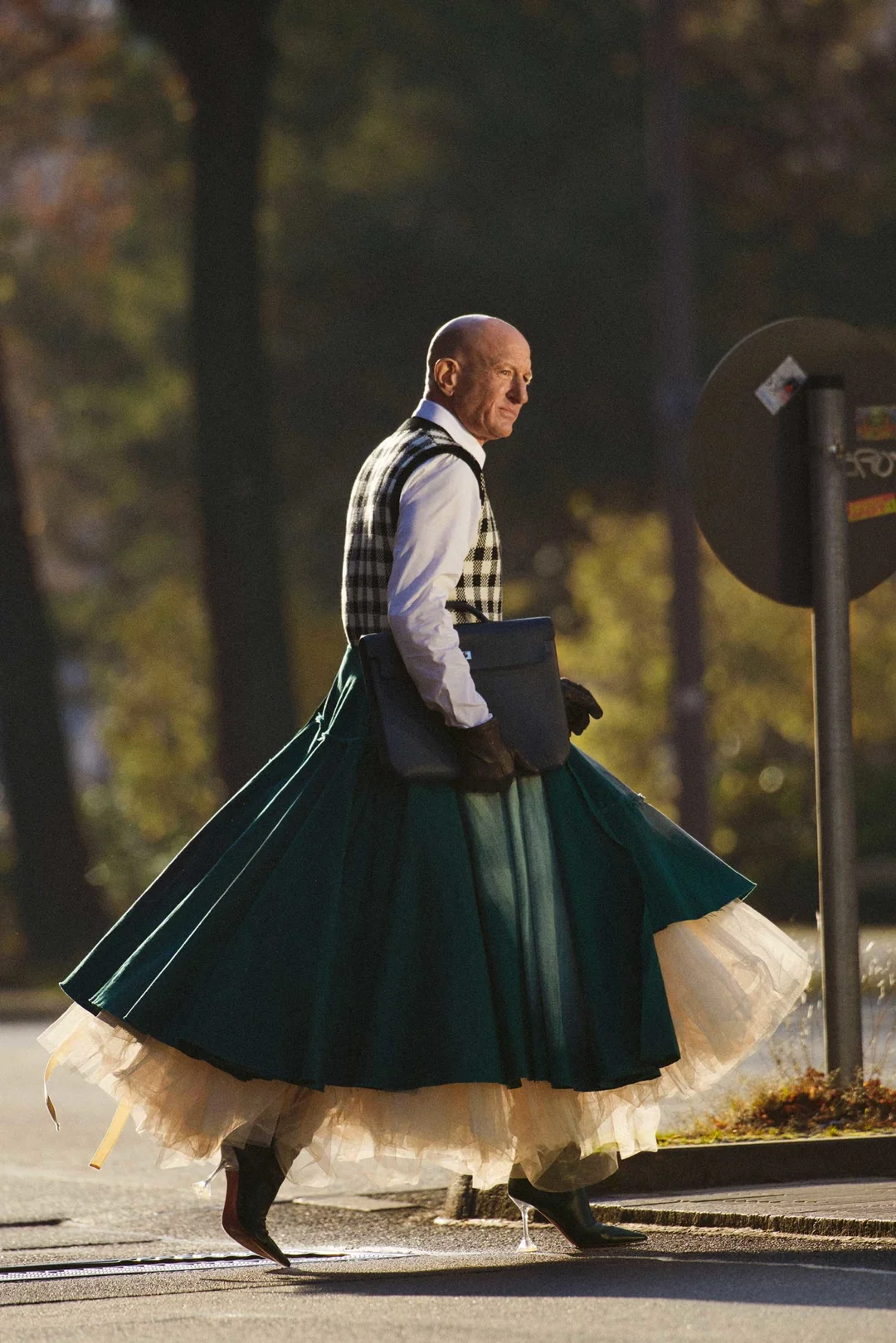
“People look at my pictures and they instantly assume I’m gay or something. I think what really gets me going are the people who say that I’m helping them see things the way that they’ve always wanted to see them, but were afraid to.”
A man struts down the street in a skirt, drawing shocked gazes and frowns of disapproval. For a GenZ-er like me, this is an impressive feat of fashion, a rebellious statement of self-expression otherwise cloistered by the stifling rigidity of stereotypical fashion rules.
Enter cross-dressing fashion, a movement that aims to shatter the traditional rules that confine certain genders to one area of the wardrobe. More importantly, the main premise of this growing trend is that fashion silhouettes should cater to the needs of the entire gender spectrum, be it cisgender, transgender, or anything in between.
Throughout the years, fashion has been a benchmark for one’s gender expression, whereby the primordial binary code was the sole rubric for garment design. There have been attempts to tie their gender expression to physical pieces of fabric, constantly eluded by the fact that gender is ever-changing, fluid and not polar. Thus emerged the rise of the cross-dressing or androgynous fashion movement. Slowly, the lines between the discrete identities of “male” and “female” began to blur, blending into the amorphous, and giving rise to multiple identities on the runway.
The nondescript silhouettes challenge one to look beyond deeply sedimented gender doctrines, calling into question the dubious origins of gender: is it biological or cultural? Cross-dressing fashion thrives on the power of personal choice, emphasizing the need to challenge the sartorial mainstream in order to accomplish the inclusivity so desperately needed, both on fashion runways and in everyday society.
Although women have been wearing suits for years, it is the emergence of a more effeminate male fashion that now holds the runway audiences in awe. The use of colorful fabrics and ornamental detail has allowed males, even those identifying as heterosexual cisgender, to express themselves whichever way they please. Some men even prefer “female” pieces for the comfort and functionality they afford. The strictness and boxiness of male garments echo the lofty standards of being the ultimately masculine breadwinner. Cross-dressing fashion has thus, at least symbolically, relieved the pressure placed on males in today’s society, unabashedly allowing them a much-needed outlet of self-expression and exploration.
Indeed, there are many well-known figures who have refused to be policed by mainstream expectations, opting for androgynous anarchy instead. These include David Bowie and Prince, whose ensembles were the talk of the 1970s. Star Trek, a pivotal piece of popular culture, demonstrated the evolution of the uniforms worn by female crew members, from plunging necklines and miniskirts, to more functional and egalitarian jumpsuits. Nowadays, celebrities have hopped on the androgynous bandwagon as Kristen Stewart, Ezra Miller, Jaden Smith, Billy Porter, and Ava Grey all echo the sentiment of the cross-dressing movement.
In spite of this progress, there remains “something missing” as visual sociologist Floriane Misslin finds while studying fashion photographs. There is a blatant under-representation of cross-dressing appearances on camera. It is not uncommon for agencies to staunch the visual representation of non-binary gender identities, fearing the reaction this would elicit from major brands. Thus, fashion proliferates the already entrenched heteronormative tenor, while cross-dressing remains on the sidelines.
Another faux-pas is the simple mannequin. Though it is the predominant method of exhibiting clothing, it unfortunately exacerbates the binary code too. These tall, willowy, and overall uniform figures do not only invalidate certain body types (“fat”, able-bodied…), but also dismiss the ever-changing bodies of trans people undergoing hormonal therapy. They represent an ideal that cannot be lived up to. Moreover, their obvious sexual markers can be deeply unsettling to those identifying as gender-neutral, i.e those who do not want to associate their biological genitalia with their gender identity.
Luckily, the Boston Museum of Fine Arts chose to eradicate this troubling homogeneity in their aforementioned 2019 exhibition, by utilizing mannequins with minimal gender markers, thereby drawing the eye to the garments themselves, and not the obligatory bodies they are made for.
Moreover, it is critical to draw attention to brands that enthusiastically capitalize off of clashes in the identity politics arena, by sporadically allying with gender activists, only to return to rampant gender practices. The distressing narratives of an entire cross-dressing community are reduced to mere publicity stunts, especially when heteronormative models are featured in these clothes on the covers of magazines. Even when the gesture means well, the garments are very elitist, afforded only by the rich, and closed off to the very people who need them.
It may very well be the political responsibility of the fashion industry, a fertile medium long known for its ability to bear difficult conversations, to drag these spurned dialogues to the surface. Dialogue that is too formidable to put into words may very well flourish on the runway or in window displays. Misslin could not have been more innovative when she suggested the use of visual diagrams, better coined “diagrammatic manifestos”, to amplify the outraged voices of the factions of the fashion world. Be it the voices of models, photographers, or designers, whose embodiment of cross-dressing fashion expression is constantly dismissed.
It is important to remember that everything discussed so far pertains to the Western world, but after all, this problem, this binary, was created by them. While the West emphasized voluminous skirts and trousers, the East preferred more holistic garments that prioritized comfort over rigid gender conformity. Cultures throughout history never hatefully scrutinized the association between men and wearing skirts.
Sang Thai, a designer and lecturer at RMIT University, a university in Melbourne, Australia, describes the predominant view of masculinity as “Western-centric.” Similarly, researcher Myriam Couturier confronts the overbearing binary code prevalent in both Europe and the United States.
This strict gendering of clothing was brought from Europe to North America with the European settlers themselves: Native Americans had no problem with gender non-conformers. In fact, indigenous communities in North America honored and respected this fluidity. People who were assigned male at birth but tipped towards the feminine side of gender expression more than “masculine men”, and vice versa, were qualified as Two-Spirited. They subsequently had no strict gender roles and were usually assigned whatever duties matched their personal skills and affinities. The same goes to their clothing. It was entirely up to the Two-Spirited to choose whether to cross dress or wear the traditional clothing of their birth sex. The practice was cruelly shamed by Europeans and Western heteronormative ideals.
In times of turmoil, uncertainty, and political turbulence, we would do well to remember that clothes, essentially a layer of fabric protecting our bare, furless skin, are also a solid shell, mirroring our identities and shielding our naked souls from another’s gaze. This outlook does not only progress our feminism, but is also decolonial.
Edited by Layann Halawi