

A core element of the university campus experience is the extracurricular activities students can participate in. The campus experience constitutes clubs, societies, and even student spaces designed to cultivate social involvement among the students as well as generate creative opportunities that encourage them to sharpen their organizational and leadership skills. AUB is known for having a wide array of clubs and societies students can choose from, but in recent years, AUB clubs have been plummeting in terms of variety, availability, and quality, which has led to an overall deterioration in quality of student life.
The presence of clubs on a university campus has always been a fundamental part of student life, but after the March 2020 COVID-19 lockdown, it became even clearer why these extra-curricular activities, which may have previously been taken for granted, play such a big role for the students.
Initially, during the lockdown, it took clubs a while to get back on their feet and adapt to the completely remote environment we were all forced to navigate. Some clubs, mostly those that have always been media-driven such as the eSports Club and Cinema Club, had no problem hosting online gaming tournaments through Discord or hosting a film screening through Zoom. The issue that mainly arose was with the clubs that required physical presence and couldn’t remodel their events into something more Zoom-friendly. The Archery Club had one Zoom-based event in which they used a digital model to teach their members Archery skills, but despite their wonderful efforts, an activity like that really needs to take place in person with the appropriate equipment.
While platforms such as Zoom or WebEx made it possible for many of the extra-curricular activities to carry on, I find that they also made everything undeniably underwhelming for students. For example, the 37th edition of AUB Outdoors took place over Zoom with many international and Lebanese artists tuning in. Still, one can’t help but laugh at the irony of a festival that had previously brought in up to 20,000 attendees in one weekend being held on Zoom. Another example is the 2021 Harvard World MUN, which was meant to be held in Japan rather than over video chat. These are just two examples of many that show just how much COVID-19’s circumstances minimized potentially amazing and diverse experiences for students.
In recent years, there has been a notable decrease in the clubs available at AUB. A WordPress blog titled, “AUB Mentors,” which dates back to 2014, has multiple posts aimed at helping students navigate life at AUB. One of these pages asked the question, “Which Clubs and Communities Should I Join?” It had an extensive list of clubs one could join at AUB and I couldn’t help but notice how many of these clubs no longer existed. A few of these now-discontinued clubs are the Drama Club, Fashion Club, Latino Dance Club, and many more. Of course, some of the clubs on the page still exist under different names or have sectioned off into sub-clubs with similar goals. For example, what is listed on the page as Environmental Club can be classified with what we now have as Save Our Sea Club and the Sustainable Energy for All Club. But there are still many missing clubs that simply no longer exist such as the Dabke Club or the Cinema Club. Most of these clubs were simply abandoned after the lockdown; no one had taken them over and their previous presidents didn’t make the necessary effort to elect a cabinet that would ensure the club would move forward after their graduation.
In AUB’s archives, there are multiple examples of how activity in the AUB club scene has decreased. In an AUB Bulletin issue from 1977, an advertisement was printed about the Drama Club offering two plays during January, “The Bear” and “Suppressed Desires.” This was particularly interesting for two reasons. Firstly, the Drama Club no longer exists. Secondly, two plays in one month is a level of activity that today’s clubs can only dream of. Even when the Drama Club was still active in the late 2010s, the most they would be able to host was one play per semester.
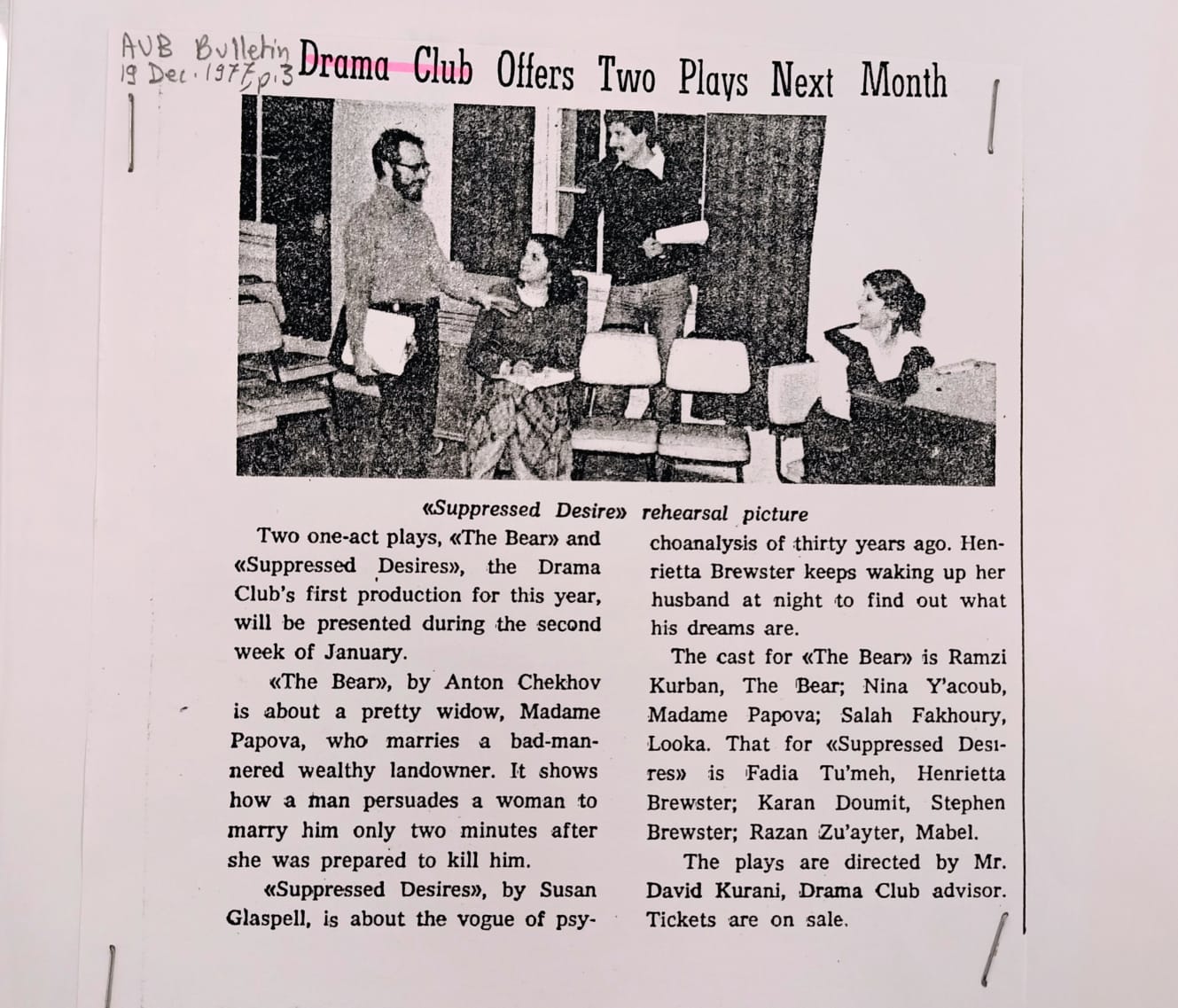
AUB Bulletin (December 19, 1977)
While I understand that maintaining a club is difficult, shouldn’t the university make some sort of effort to keep these clubs alive? Promoting these clubs, and a generally more active campus environment, keeps students’ options varied and encourages much more social interaction between the student body. While AUB does provide some monetary support for these clubs, more effort needs to be made to ensure that they will not fade away and eventually shut down.
In terms of finances, one source I spoke to described how she left her position as president of one of AUB’s clubs as a result of her frustration with how things are run on campus. AUB students are charged $10 when they enroll in a club, so she attempted to collect these funds in order to host club events. She was turned down by AUB, who insisted that they should keep the fees since the money was for “renting out classrooms and auditoriums.” This was particularly frustrating to her since, as (very high) tuition-paying students, we already had access to these places. “It was so difficult to keep the club alive, it felt like all the odds were stacked against us.” Rather than doing things that the cabinet deemed ‘fun,’ they had to host events that were financially convenient for them since they were paying out of pocket.
A conflicting source, an ex-treasurer, stated that AUB would ask them to pay fees, but would reimburse them if they submitted the respective receipts. But amidst the entangled web that is AUB’s bureaucracy, that is not always an easy or straight-forward process.
I also find that some clubs are heavily championed when they are able to provide AUB with some sort of merit, such as the AUBMUN Club which travels abroad annually to compete against other schools. Their privileged status among AUB’s clubs can be seen in the amount of time and resources the University Student Faculty Committee (USFC) dedicates to them. They held a “Special Meeting” in February this year dedicated to funding BEYMUN, while in 2018-2019 the USFC decided to fund AUBMUN with $16,000 and BEYMUN with $5,374. There were no similar special meetings or extensive discussions about other clubs, or about tuition. Sure, these clubs are important and deserve the praise, but other clubs need to exist as well, especially ones that appeal to the students who don’t find that they fit into any of the university’s current clubs.
Clubs help boost attendance in university and allow students to flourish socially, which is a good combination for a student to perform better academically. These extra-curricular activities have the power to make or break someone’s campus experience – especially those enrolling into the university without their past classmates. Clubs have historically also been hubs for social and political demands on campus, and have led the way in fostering a more collective campus environment. Amidst the current rampant individualism in universities globally, and with most clubs now becoming just a thing to add to a CV, lively and engaging clubs can help alleviate some of the issues plaguing the student body today. For this reason and many more, I want to call for better upkeep of the clubs and for students themselves to bring in new,and bring back old, clubs, such as the Astronomy Club, Fitness Club, Drama Club, Fashion Club, Cinema Club. The options are endless, and if we want clubs to be more than pit stops trapped in bureaucracy, we need to move toward creating real and cooperative communities on campus.
Edited by Karine Ballout