
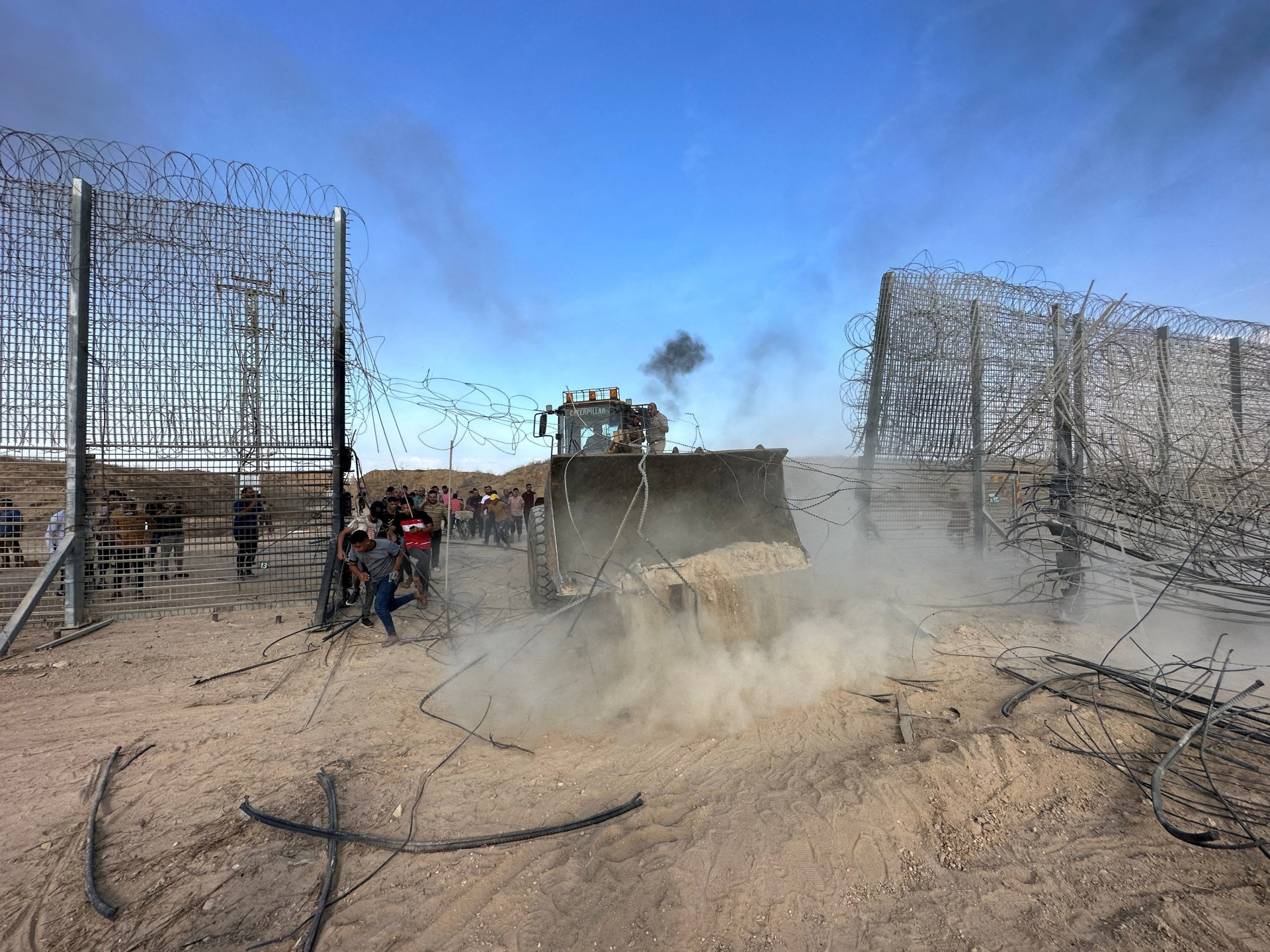
When will Palestine be liberated? That has been the most answered and unanswered question of the past 76 years. Who will liberate Palestine? That question is a little more controversial. How will Palestine be liberated? By gun, by sword, or by United Nations Resolution 9056.1/028×3. What will Palestine look like after liberation? We have heard a lot about one, two, three, or no states, but the actualities of Palestine’s liberation have more than often been relegated to the drawing boards and backrooms of camps David.
The long and ruthless assault unleashed on Gaza since October 7 has only reinforced the difficulty of speaking about liberation. This was of course one of the main objectives of the war. It is no surprise that ideas of liberation are stifled and crushed when the harshest horrors of the 21st century are being released on a daily basis. The misery of bearing witness is combined with repeated reminders of (almost) everyone’s fundamental powerlessness to do anything about it.
So how do you speak about liberation in this context? A lot of people, justifiably, turn back to more radical times for inspiration. Ghassan Kanafani, in black and white, asking whom they should talk to. Leila Khaled recounting how it felt to see Palestine from the sky. The bravery of the unknown soldiers of the intifadas. In the grand context of history, 1970 and 2000 are pretty close to 2024, but no one would deny that the world is fundamentally different.
The world today does not stop. It does stop on days like October 7, and you could argue it even slowed down for a select number of weeks after it. But the world kept churning on. Of course, this is not an argument about the level of emotional devastation or “care.” A person can easily, and truthfully, claim that they have been “feeling it” every day since October 7. However, it is the world’s constant motion, its destructive drive forward, which tempers more radical feeling and action.
Fundamentally, there are two types of people in the pro-Palestine camp. The first are the persons completely committed to achieving liberation, at any cost. They are murdered, encamped, imprisoned, and ruthlessly repressed. The second are the persons who believe in Palestinian liberation. Students are not the biggest part of this group, but form a significant bloc. They are ready to mobilise for Palestine, but in more supportive capacities. They are more prone to “getting busy,” with exams, jobs, families, etc.. There is not a clear demographic, or even class distinction between these two groups, as they represent more abstract categories for force within people.
In more radical times, these two groups, or more accurately currents, would be brought together under the auspices of larger popular organisations, such as Fateh, the PFLP, or even just the larger PLO (to varying levels of effectiveness). Put in a complementary relationship, and not necessarily a top-down line, the force of both groups could be utilised toward objectives of liberation. Whatever one has to say about the tactics and strategies employed toward Palestinian liberation since 1948, it is undeniable that the current iteration of the movement is as fragmented and alienated as ever.
The only way to counteract the world’s constant crushing motion is by getting enough mass to stand in front of it. Outside of the organised resistance in the region, there is not enough mass behind the movement. Millions can protest in Jordan, but if they are lacking the revolutionary oomph to penetrate through the zionist lackey state’s walls, it will not lead to anything. Millions can claim to support Palestine in Egypt, but the same story goes there. They are a brave few who end up paying the price of commitment while the majority returns to work the next day.
In their defence, Jordanians and Egyptians can easily point to the horrifically repressive state apparatuses that have been formed specifically to quell anti-Zionist resistance in those two countries. And they would be right in that. But what comes next? The list of Zionist collaborations in the Arab world continues to grow, this time publicly rather than in the backroom collaborations of the 20th century. The imperial order will only get more destructive in its supposed decline, and a century of counter-revolutions in the Arab world are very acutely felt.
The fundamental question remains if Palestine will free us or if we will free Palestine. It is the former framework we are currently living in, where we are pushed by the bravery and spirit of Palestinians’ continued fight. But they only represent around 0.001% of the world’s population, and it is an even smaller percentage within that group that is actively moving toward liberation. What does “us” freeing Palestine look like? External reclamation of Palestine was the modus operandi for resistance factions after the 1967 war. Although this era is remembered more for its setbacks, i.e. Black September, Anwar el Sadat, the 1982 War. It is worth remembering that setbacks usually occur when power is being accumulated. We have not had any external setbacks in the post-Oslo era because the thrust of liberation was now moved internally, where it can be more easily managed and crushed.
The liberation of Palestine will look like the liberation of the entire world. Fundamental imperial dynamics will have to be broken. The supply chains, trade routes, and relentless motion of the machine will need to be stopped. It requires a mass weight to tip over the rotation of the Earth.
When we imagine the liberation of Palestine, we must imagine the end of life as we know it. And not in a third temple Evangelical sort of way. The Universal Declaration of Human Rights was adopted in the UN on December 10, 1948. The next day, December 11, the UN stipulated that any “refugees [from Palestine] wishing to return to their homes and live at peace with their neighbours should be permitted to do so at the earliest practicable date.” The earliest practicable date has still not come. When it does come, a fundamental pillar of the post-world war two order will have to come barreling down. Palestine is not the exception to human rights law, or international law, or universal justice, or liberal equality, it is the blood on which the order is built.
Edited by Malak Mansour