
The state, with all its institutions, became a tool that is constantly employed for the continued functioning of the neoliberal system. Although advertised as a system separate from the state in terms of the freedom of the market and individual choice, the neoliberal system depends on the state for its maintenance. For the function and continuity of the neoliberal state, the extension of control to all major institutions becomes crucial. An indispensable part of this process is the utilization of educational institutions, particularly university institutions, which continue their development in line with market demands. To better understand the system through which the state operates, we must understand how its essential institutions, starting with university institutions, function.
Taking the Lebanese state into specific consideration, we can apply this understanding by comparing its two major universities; the American University of Beirut (AUB) and the Lebanese University (LU). The Lebanese University is punished by the state structure by being affordable and open to the public. Not only does it lose its social capital and reputability to the Lebanese public, but also systematically lacks the basic resources that must be present in any university. This goes back to the absence of the state’s role in funding public education because of its built-in individualist and free-market system in the neoliberal structure. The American University of Beirut, because of its adherence to neoliberal ethics, is rewarded by gaining social and financial capital. This does not happen merely by chance; instead, the state invests in the creation and maintenance of the private institution. In terms of social capital, AUB is generally known among the Lebanese public to be the most prestigious university in Lebanon. On the global level, the university was accredited by the Commission on Higher Education of the Middle States Association of Colleges and Schools in the United States. Many financial benefits come with this accreditation including international funding by many organizations, institutions, and companies, even including United Nations agencies.
When we enroll in a university, we do not realize we are becoming part of an economic arrangement where we are exchanging huge sums of money for a degree that guarantees a much higher success rate in the state structure. Before enrolling, students view campaigns of different, especially private, universities as if they are advertisements. The university itself distinguishes between the ‘good’ and the ‘bad’ students based on their potential to be used as a market tool. Students who are active in the part of university life that goes toward profit-making and career building become prominent figures in the advertisable part of university student life. On the other hand, students who challenge, in any way, the framework upon which the university is organized, become a threat to the integrity of the neoliberal institution and its place in the state structure. From here, it is also clear that private institutions are molded according to the needs of the neoliberal state.
The second level of analysis comes from the university institution’s structure itself being a model of the organization of the state. This is applicable in terms of, and not limited to; structure, hierarchies, market rationality, securitization, surveillance, and militarization. The university, in a way that is almost identical to the state, resorts to violent methods for the protection of its market freedom. The American University of Beirut not only employs its security to protect the ‘borders’ of its campus, but also to violently stop specific student action and political activism. For instance, when students in AUB organized protests in rejection to the dollarization of their tuition fees, state security was called to quell the student action, even directly firing tear gas at students. In another instance in 2025, students who gathered in front of AUB’s main gate in a show of solidarity with Palestine, were physically and forcefully moved by AUB’s security for “blocking the entrance to campus”.
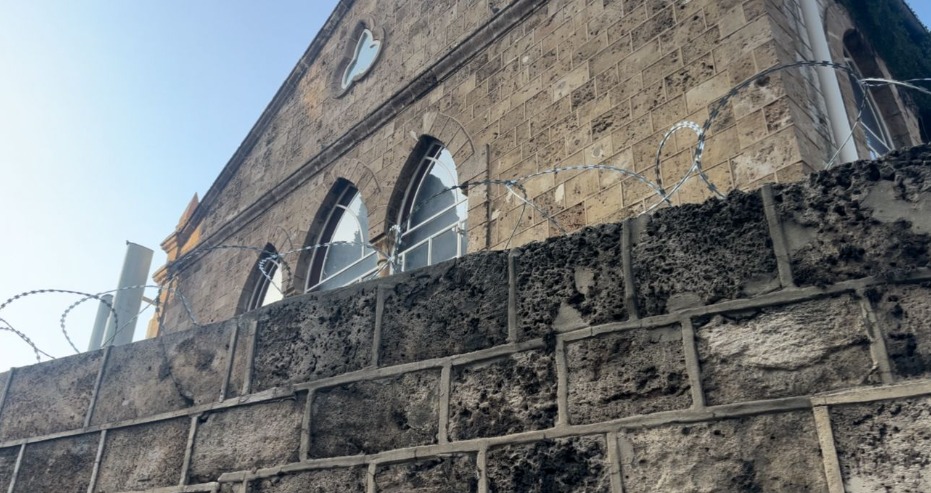
Militarizing university campuses, therefore, becomes essential in controlling and creating a student body that acts as an unthreatening subject to this institution. This comes with the university campus itself being walled off from the rest of the area and even surrounded with barbed wires. Every corner in and outside of campus is also constantly surveilled. The entrance of the physical borders of the university are also limited to students who hold an AUB ID and swipe it on a smart card reader while they are entering and leaving university, making it an ideal tracking system.
The militarization of university campuses and policing of students became evident in the most recent global student action for Palestine, ranging from strikes, to encampments, to protests. Students who participated in these forms of action were villainized by the university, and in extension, by the state. Going back to the nature of the university as a corporation, threats students would be subjected to would come in the form of withdrawing the benefits they gain from the university; such as aid, scholarships, financial benefits, and even suspension from the university. Direct interaction between the state and universities facilitate university suppression of student activism. For instance, the university institution has the privilege of utilizing state police for quelling a student movement, which has happened in multiple cases around universities globally. This is because university institutions have adopted very similar structures in all parts of the world where the neoliberal order became prominent. Not only do private universities become similar in structure, but also naturally adopt the same methods. The student now sees their future career as a price they paid for their activism. It must become clear to all students that a university works in the form of exchange. Education is commodified in the form of a degree sought out by students in exchange for achieving impossible standards that maintain the university’s market values.
My dad, seeing my excitement for being accepted to the American University of Beirut, urged him to keep reminding me “to them, you are just a walking dollar sign”. I did understand what he meant, but I never thought of it as deeply as I do now. This one line he used to pass to me as a joke now summarizes my whole university experience. Through it, I understand that I was sold an education packaged with tools that wanted to make me a neoliberal subject. However, I also understand that my life as a citizen in the global neoliberal order depends on my university degree for my survival. A university degree that represents the beginning of my integration in the state structure. However, as much as we think we need the university institution’s recognition for our employment in the career market, they also, and even more strongly, need us to uphold their structure. Our dependence on state institutions will only stop when we realize how much more they are dependent on us, and this will make us act accordingly. This applies to all aspects of the neoliberal state, from the university institution to the wider governmental structure and global order. This is why it is important for systematic change to start from educational institutions and extend to other aspects of the state.
Edited by Amin Kharrat and Nisreen Yassine